
Chimera TCG
Bauman GamesCard
4.494.00 Reviews
- Version
- 1.23.28
- Installs
- 10.00K
- Age Rating
- Everyone
Screenshots
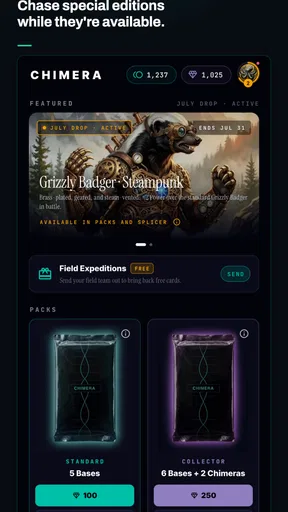

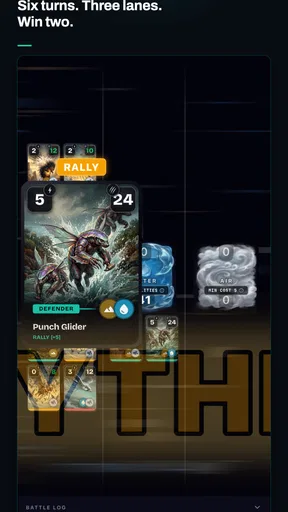
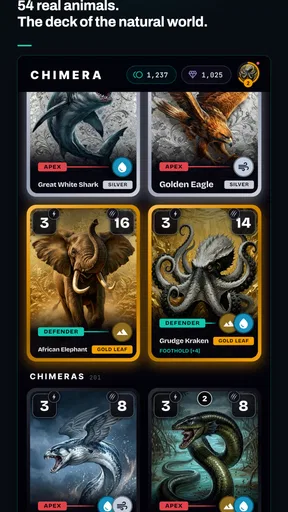
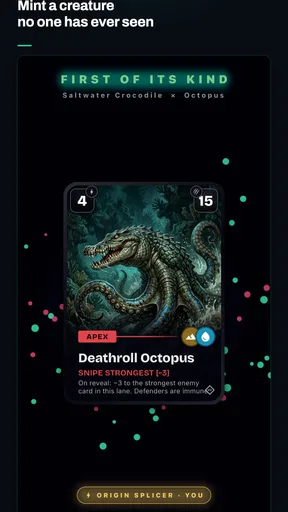
Our Review of Chimera TCG
 Analysis by Appyee
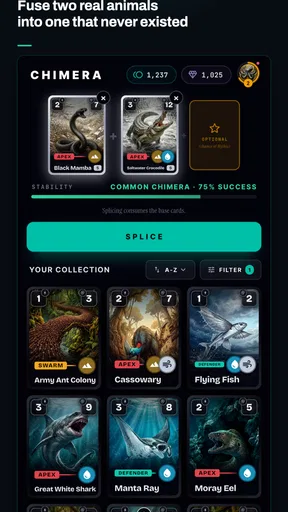
My first reaction to Chimera TCG was that its central idea is much more memorable than the usual fantasy-card setup. Instead of asking me to collect familiar heroes or another set of interchangeable monsters, it builds its identity around combining real animals into strange new creatures and then using those creations in card battles. That gives the game an immediate visual hook, but the important question is whether the unusual art direction supports a satisfying card game rather than simply decorating one. After spending time with it, I think the answer is mostly yes, especially for players who enjoy experimenting with combinations and learning a game through short, focused sessions.
Bauman Games presents this as a free card game for everyone, with a current version of 1.23.28 and support for Android 7.0 or later. Its average rating sits at 4.4 from around 272 ratings, while the game has passed 10K installs. Those figures suggest a smaller community than the giants of the mobile card genre, and that is useful context: this feels like a distinctive niche game to investigate, not a huge established ecosystem where every deck idea has already been solved by thousands of players.
Why the first few matches feel different
The opening appeal comes from the creature-building premise. A lion, bird, reptile, or other recognizable animal is easy to understand on its own, but splicing those identities together creates a playful tension between the familiar and the absurd. I found that this makes every new creature feel like more than a piece of artwork. It becomes a question: does this combination make sense as part of my battle plan, or am I choosing it only because it looks entertaining?
That distinction matters in a trading card game. A collection can be attractive without being interesting to play, while a clever ruleset can lose people if its presentation feels lifeless. Chimera TCG works best when the visual surprise leads me toward a decision. I want to inspect a creature, think about where it fits, and then see whether that idea survives contact with an opponent. The game’s strongest hook is therefore not just “look at this strange animal,” but “what can I do with this strange animal?”
The free entry point also makes sense for this kind of experience. I can approach it as a curiosity, play enough to decide whether the combination system suits me, and avoid committing to a purchase before understanding its rhythm. There are in-app purchases ranging from $0.99 to $99.99 per item, so I would advise treating the free download as an opportunity to test the game rather than assuming that every part of collection growth will remain equally comfortable without spending.
One practical habit helped me enjoy the early experience more: I stopped judging a creature immediately by its appearance. The most amusing hybrid is not automatically the most useful one, and the visually plain option may fit a developing strategy better. That sounds obvious, but it is easy to get distracted by the game’s novelty. I recommend first asking what a card contributes to a battle, then appreciating how strange it looks. This keeps the art from becoming a substitute for decision-making.
A world built from recognizable animals
The setting communicates through creature design rather than a long story premise. Real animals act as the visual vocabulary, and their combinations supply the game’s personality. That gives the world a readable foundation: I do not need a glossary to understand why a familiar body shape feels threatening, agile, defensive, or simply bizarre. The fantasy comes from recombination, not from burying the player under invented terminology.
I like that approach because it keeps the cards approachable. A completely original creature can be difficult to remember when a collection begins to grow, but an animal-based silhouette gives me something to hold onto. Even when the hybrid is unfamiliar, some part of it usually suggests a role or mood. That is a subtle advantage for a card game, where recognition matters during quick decisions.
At the same time, this visual language creates a limitation. Players who want a deep narrative world, named factions, or an elaborate campaign setting may find the premise more compelling than the surrounding fiction. The animal combinations are the main conversation starter, not a replacement for a large lore-driven universe. I would choose a more story-heavy card game if my priority were character arcs, dialogue, or a carefully explained mythology.
The art direction also changes how I think about collecting. In many card games, collecting is mainly about chasing rarity or building an efficient list. Here, there is an extra layer of personal taste. I may remember a card because its hybrid is funny, elegant, unsettling, or unexpectedly coherent. That does not make the collection automatically meaningful, but it gives the act of browsing a stronger emotional texture than a plain catalogue of effects.
A useful way to organize a growing collection is to separate cards into three mental groups: pieces I understand strategically, pieces I want to test, and pieces I simply enjoy seeing. That prevents the common mistake of dismantling every unusual idea before it has had a fair trial. It also acknowledges that a collectible card game can serve two purposes at once: solving battles and building a personal gallery of creatures.
Sound, pacing, and the mood between decisions
The game’s mood depends heavily on how it moves from one decision to the next. The animal concept could easily have been presented as loud comedy, with every hybrid treated like a punchline. Instead, the playable mood works better when the strange designs are allowed to sit alongside the seriousness of a card battle. That contrast is part of the charm: the creature may look ridiculous, but the decision about when to use it still matters.
Sound is most valuable here when it supports clarity and momentum. In a card game, audio should help actions feel finished without making every turn feel like a spectacle. I prefer a rhythm in which I can inspect my options, commit to a move, and immediately think about the opponent’s response. When presentation becomes too busy, it competes with the tactical layer; when it is too flat, the collection loses some of its personality.
That makes Chimera TCG better suited to short breaks than to players seeking a dramatic, cinematic session every time they open a game. I can imagine playing while waiting for an appointment, during a commute as a passenger, or in the evening when I want something more interactive than scrolling. The creature designs provide enough visual interest to make a quick session feel distinct, while the card format gives me a reason to return with a different plan.
My main pacing advice is to avoid rushing purely because the game looks playful. The unusual art can create the impression that matches are lightweight, but card decisions still deserve attention. I found more satisfaction when I treated each turn as a small puzzle: identify the immediate threat, check which option preserves flexibility, and only then choose the most entertaining move. That approach also reduces the frustration of losing to a decision I made for visual novelty rather than tactical value.
Players who want constant action may need patience. Card games naturally include pauses for reading, comparing, and anticipating, and Chimera TCG’s appeal depends on those moments having room to breathe. If I want an instant arcade loop with almost no planning, this is not the right kind of game. Its atmosphere is playful, but its best moments come from the space between seeing a card and understanding how to use it.
Where the creature concept meets card strategy
The central mechanical attraction is the relationship between collecting unusual creatures and battling with them. That relationship gives the game a clearer purpose than a simple creature showcase. I am not only gathering designs; I am trying to understand how they behave in a deck or battle context. The strongest loop is the one that sends me back to my collection after a match with a specific question: would another combination solve the problem I just encountered?
This is also where the game asks for discipline. A large collection can create the illusion of progress even when my actual understanding remains shallow. I get more from it when I change one idea at a time rather than rebuilding everything after every loss. If I alter several cards together, I cannot tell which change improved the result. Testing a single creature or a small combination makes the learning process slower, but much more useful.
Another non-obvious trade-off is the balance between experimentation and consistency. Hybrid creatures encourage creative choices, yet a battle deck still needs a dependable plan. A collection full of individually exciting cards may perform worse than a less glamorous group that works together. I would therefore keep a stable core while reserving a few spaces for experiments. That gives me a reliable baseline and lets the game’s imaginative side influence the strategy without taking it over.
The game is likely to appeal most to people who enjoy card games as systems of small interactions. You do not need to be an expert deck builder to begin, but you do need to enjoy reading a situation and adjusting your plan. The animal theme makes the entry point friendlier than a dense science-fiction setting, yet the underlying appeal still comes from choices, not from collecting alone.
It is less suitable for someone who wants a completely predictable progression or a purely cosmetic collection. If my goal is simply to unlock every attractive creature and never think about how they function together, the battle layer may feel like an obstacle. Likewise, players who dislike free-to-play economies should pay attention to their own spending habits. The presence of optional purchases, especially with the upper price reaching $99.99 per item, means I would set a personal limit before becoming invested in collecting.
The age rating of Everyone broadens its audience, and the animal theme is easy to share with younger players. Still, “appropriate for everyone” does not mean every player will find it equally engaging. A child may enjoy the combinations immediately, while an experienced card player may focus on balance and strategic depth. I would introduce it differently depending on the person: as a creative creature game for a casual player, and as a compact deck-building experiment for someone already familiar with trading card games.
How it compares with familiar card-game alternatives
Compared with a traditional card game, Chimera TCG has a stronger identity before I even examine the finer tactical details. Classic digital card games often rely on established suits, heroes, or fantasy classes that are easy to recognize but not always surprising. Here, the animal-splicing idea gives the collection an immediate sense of discovery. If I want a game that looks unlike the usual knights, wizards, and monsters, this is the more distinctive choice.
The trade-off is that established alternatives usually offer a more obvious learning path. Their card roles may be familiar, their communities larger, and their strategic conventions easier to find. Chimera TCG feels more personal and exploratory, but that can also mean I have to do more of my own testing. I would choose a mainstream competitor when I want a large competitive scene or a deeply documented meta; I would choose this one when the joy of figuring out unusual creature combinations matters more.
It also differs from purely casual matching games. Those games can be ideal when I want a few seconds of input and immediate feedback. Chimera TCG asks for more attention because the collection and battle relationship is the point. The reward is a stronger sense of ownership over my choices, but the cost is that I cannot always play on autopilot.
For a realistic everyday scenario, imagine having ten minutes before a meeting. I would not use that time to redesign an entire collection. I would open the game, play a focused match, and remember one interaction that caused trouble. Later, I could return to that specific problem and test a creature swap. This two-step workflow is more effective than trying to solve everything in one sitting, and it suits a mobile card game that can be approached in small pieces.
Another good use case is playing alongside a friend who enjoys inventing characters or creatures but does not normally choose competitive card games. The visual premise gives you something to discuss immediately, while the battles provide a shared test for those ideas. The game does not need to be treated as a serious tournament platform to be worthwhile; it can work as a conversation starter that gradually reveals more strategic detail.
Who should download it, and who should pass
I would recommend Chimera TCG to players who like collecting, experimenting, and comparing unusual creature concepts. It is especially appealing if the visual identity of a game matters to you but you still want the collection to feed into actual battles. The free price makes trying it straightforward, and the Everyone rating makes it an approachable option for a broad audience.
I would be more cautious if you need a huge player base, a strongly narrative campaign, or a completely transparent long-term economy. The game’s smaller footprint can be part of its charm, but it may not provide the same sense of scale as the biggest card titles. I would also skip it if I know that optional purchases make me uncomfortable once collecting becomes engaging. Setting a budget before playing is sensible, not because spending is required for enjoyment, but because the available purchase range is wide.
Device compatibility is another practical consideration. Support for Android 7.0 or later covers older devices, which is helpful if I am not using a recent phone. Even so, I would keep expectations realistic: an older device may make a visually focused card game feel less comfortable during longer sessions than a newer one. The best experience comes from a screen where creature details and card information are easy to inspect.
Bauman Games has made a game whose personality is clear from the moment the animal combinations appear, but the lasting value depends on whether I enjoy turning that personality into decisions. The artwork gets me interested; the battle loop determines whether I stay. That is a healthy relationship between presentation and mechanics, because neither side has to carry the entire experience alone.
The atmosphere verdict
After playing it, I see Chimera TCG as a compact, characterful card game built around the pleasure of making the familiar strange. Its art direction gives the collection a recognizable voice, its setting stays readable through animal-based designs, and its pacing suits short sessions when I am willing to think rather than simply tap through them. The mood is playful without making the card battles meaningless.
My strongest recommendation is to approach it as an experiment. Do not chase every attractive creature immediately, and do not assume that the funniest hybrid is the best battle choice. Keep a dependable core, test changes methodically, and let the visual appeal guide curiosity rather than replace strategy. That approach reveals more of what the game is trying to do.
Chimera TCG is at its best when imagination and tactical restraint meet. I would download it for the creature concept, stay for the process of discovering useful combinations, and recommend it to anyone who wants a card game with a more unusual visual language. It is not the universal answer for competitive card players or lore hunters, but for a free, approachable experiment with a clear identity, it leaves a more distinctive impression than its simple premise first suggests.
Verdict
Strengths of Chimera TCG
- Strategic deck-building offers plenty of room for experimentation.
- Matches are engaging for players who enjoy tactical card battles.
- The fantasy-themed artwork gives the game a distinctive visual identity.
- Regular card additions can keep the metagame feeling fresh.
- Suitable for both quick sessions and longer strategic play.
Limitations of Chimera TCG
- Learning card interactions may be challenging for new players.
- Competitive progression can feel demanding without optimized decks.
- Random card draws may occasionally decide otherwise even matches.
- The player base may be smaller than in major TCG titles.
- Some features may require purchases or extended grinding to unlock.
Similar Picks in This Category
View All
Solitaire - Classic Card Games
MobilityWare4.6

UNO!™
Mattel163 Limited4.3

Spider Solitaire: Card Games
MobilityWare4.6

Solitaire.com - Classic Cards
Tripledot Studios Limited4.7

Plants vs. Zombies™ Heroes
ELECTRONIC ARTS4.1

Hearthstone
Blizzard Entertainment, Inc.4.1
Frequently Asked Questions
What is Chimera TCG?
Chimera TCG is a digital trading card game focused on collecting cards, building competitive decks, and battling other players. Its gameplay combines strategic card placement, resource management, and creature-based combat. Before downloading, players should expect a learning curve while they become familiar with card abilities, deck synergies, match rules, and the overall progression system.
Is Chimera TCG free to download and play?
Chimera TCG can generally be downloaded without an upfront purchase, allowing new players to try its core gameplay before spending money. However, optional purchases may be available for card packs, cosmetic items, resources, or progression-related content. Players who want a competitive experience should review the in-game economy carefully and check whether purchased content can significantly affect deck development.
Does Chimera TCG require an internet connection?
Because Chimera TCG is designed around digital card battles, account features, online matchmaking, and game data synchronization, an internet connection may be required for most important functions. Offline access, if available, is likely to be limited to certain menus or practice features. A stable connection is recommended to avoid disconnections, delayed actions, or interrupted matches.
Is Chimera TCG suitable for beginners?
Chimera TCG can be suitable for beginners, especially if the game provides tutorials, starter decks, guided battles, or introductory rewards. Even so, new players may need time to understand card interactions and create effective strategies. It is helpful to begin with the recommended deck, complete early missions, and study opposing cards before investing valuable resources in upgrades.
Can players compete with friends in Chimera TCG?
Chimera TCG may include online competitive features that allow players to challenge other users, depending on the current version and available game modes. Before downloading, users interested in playing with friends should verify whether direct friend matches, private rooms, rankings, or cross-platform support are offered. Matchmaking availability and community size can also affect the multiplayer experience.
Play our best games!


